Running a pension scheme? Here’s everything you need to know about upcoming changes in 2026
Hear from Silvia Knott-Martin, Client Relationship Manager at Smart Pension, about how a combination of legislative change and increased transparency is about to redefine the role pensions play in SMEs

This year, several major developments are converging to reshape the UK’s pensions environment. The progression of the Pension Schemes Bill through Parliament, the renewed focus on retirement adequacy by the reestablished Pensions Commission, and the anticipated rollout of the Pensions Dashboard later this year are all signs of an industry in transformation.
With rising expectations to support employees in achieving better retirement outcomes and long-term financial wellbeing, 2026 is a chance to take a more active and strategic approach to your pension scheme.
To help you support your employees financial future and strengthen your business, here are some of the key changes you need to be aware of, and the actions you need to take.
1. A changing legislative landscape
The Pension Schemes Bill is a major legislative change moving through Parliament, aimed at reforming pensions. It is expected to receive Royal Assent in Spring 2026, introducing significant changes to Defined Contribution (DC) schemes, including mandated investment powers, small pot consolidation, at retirement support and products, and the new Value for Money framework.
The Value for Money (VFM) framework could be a powerful tool to improve retirement outcomes for savers. Too often, pension scheme choices fail to focus on delivering strong long term net returns, which we know has a huge impact on the size of someone's pension pot. A well-designed VFM framework has the potential to move the needle towards genuine value rather than headline costs.
2. Retirement adequacy moves to centre stage
There is a growing national conversation about retirement adequacy, alongside increasing recognition that the current minimum auto-enrolment contribution of 8% may not be enough to deliver a comfortable standard of living in retirement.
The re-established Pensions Commission is expected to play a key role in reviewing the system, with a particular focus on improving outcomes across different demographics.
This includes addressing gaps in savings for all, and whether certain groups, such as women, ethnic minority communities, self-employed, lower-earners, young workers and gig-workers need different solutions.
The Commission is expected to publish an interim report in 2026. This interim report will set out the evidence base and strategic direction regarding pension adequacy, automatic enrolment, and saving, with a final report and recommendations due in 2027. Recommendations are not due to come into force until after 2030.
The State Pension Age (SPA) review is also expected to be published in Spring. It will explore whether the SPA should be linked to rising life expectancy, whether it should rise more quickly to manage costs, and whether automatic adjustment mechanisms to link the two could work.
For employers, this signals a shift in expectations. Pension provision is no longer just about meeting minimum requirements. It is about contributing to long-term financial wellbeing, and establishing a new consensus between individuals, the state and business for delivering good retirement outcomes.
3. The impact of the Pensions Dashboard
By October 2026, schemes with more than 100 members will be required to connect to the Pensions Dashboard infrastructure.
For the first time, employees will be able to see all of their pension savings, including their State Pension, in one place through a secure, user-friendly digital platform. We have successfully connected to the Pensions Dashboard which will allow our members to view and access all of their pension information seamlessly.
This level of transparency is likely to be transformative. When employees can clearly see their total retirement savings, many could realise there is a gap between where they are and where they need to be. That realisation is expected to drive a sharp increase in engagement, which could lead to more enquiries for employers.
An important point to remember is that good record-keeping is key. Encourage your employees to ensure their details e.g. name, date of birth, national insurance number etc, are correct. It’s also a good time to remind employees to confirm their beneficiary.
The current response from SMEs
Many employers are not waiting for legislation to catch up. We are already planning to improve their communications to employees, or increase their pension contributions beyond the statutory minimum.
Employers that embrace this shift early stand to gain a meaningful advantage. By integrating pensions into a wider approach to employee support - alongside financial education and wellbeing initiatives - you can strengthen engagement, improve retention, and position your business as an employer of choice.
What should you do now?
We can help you integrate pensions into a broader financial wellbeing strategy. We do this by supporting HR teams in three main areas:
- communication
- policy
- technology
Communicate with your employees
- Make pension and financial wellbeing part of onboarding to normalise saving and show employer care.
- Include a brief pension check-in during annual staff reviews.
- Offer simple, non-advice education on budgeting, debt management, and financial literacy to reduce short-term stress.
- Encourage managers to openly discuss their own approaches to pension saving, company scheme benefits and resources like MoneyHelper to demystify the topic.
Adjust compensation and payroll policies for engagement
- Implement or prioritise salary sacrifice - this is the most impactful tool, increasing employee take-home pay immediately by reducing NICs. Position it as a tax-efficient saving vehicle that boosts the employee's financial value. There is still time for employees to make the most of these arrangements before the rules change in 2029.
- Enhance contribution structure - introduce tiered or matched employer contributions. A modest cost increase yields high ROI in retention and engagement by offering an instant reward for saving more.
- Integrate pension discussions into HR processes - formally include a simple HR check-in (not advice) in annual staff/compensation reviews. Ask employees if they know what their balance is and if they’re on track with their retirement goals. You can also use Smart Pension data (like non-opt-in or average contribution rates) for HR objectives.
Leverage our technology to empower your employees
- Encourage all employees to use the Smart Pension app and online account so that they can easily manage their pension. Your Client Relationship Manager can provide resources (webinars, videos, sessions) to help HR with initial login barriers.
- Focus on functionality - we partnered with PensionLab to simplify secure and efficient pension consolidation, reducing paperwork and enabling members to manage all savings in one place. Our interactive calculators also use real-time data (age, salary, contribution) to project likely retirement income.
Looking ahead
The direction of travel is clear. Legislation, adequacy and transparency are reshaping the pensions landscape and employee expectations.
For SMEs, this is not just legislative or regulatory change. It is an opportunity to rethink how pensions support your people and your business. Those who act now will be best placed to navigate the changes ahead and turn pension provision into a genuine competitive advantage.
By embracing these tips, you can attract and retain top talent, meet duty of care responsibilities, and empower employees to achieve retirement confidence.
Contact your client relationship manager here: [email protected].
About Smart Pension
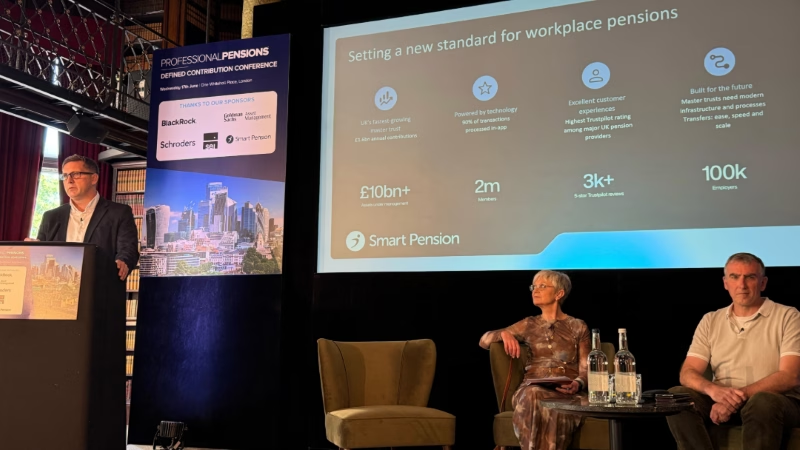
Launched in 2015, Smart Pension now exceeds £10bn in Assets Under Management (AUM) and serves 2 million members and 100,000 employers. It is powered by Keystone, Smart’s global savings and investments technology platform.
Aquiline, Barclays, Chrysalis Investments, DWS Group, Fidelity InternationalStrategic Ventures, J.P. Morgan, Legal & General Investment Management, MUFG and Natixis Investment Managers are all investors in Smart Pension.


(No%2520Text).avif)