Employer pension contributions
For the employer’s portion, this should continue to be based on the normal earnings value before the employee goes on maternity leave. In other words, this would be based on the most recent payslip before maternity began. For example, during the first period of maternity leave, a minimum of 90% of the employee’s average earnings are paid. Contributions would be based on this earnings figure and not their normal earnings value before they went on maternity leave.
Employee pension contributions
The employee portion will be based on the Statutory Maternity Pay (SMP) value calculated within the periods. For example, this could be 5% of maternity pay.
Employee pension contributions when using Salary Sacrifice
As an employer, must ensure that contributions do not lower the employee's pay to below the National Minimum Wage (NMW). If this is the case then the SMP cannot be sacrificed. Where this is not the case Salary Sacrifice can be used using the SMP value.
You can find out more about employee rights on maternity leave on the Citizens Advice website.
Statutory Maternity Pay entitlements
The table below outlines the Statutory Maternity Pay your employees could be entitled to by week and type of leave.
I’m employed but not entitled to Statutory Maternity Pay
The table below outlines the Maternity Pay you could be entitled to by week and type of leave.
Please note that the tables above align with current legislative guidance and auto-enrolment requirements, but are intended as guidance only. Employees may have preferential contractual terms, so we recommend obtaining legal advice if necessary.
You can find out more about the maternity leave your employees are entitled to on the MoneyHelper website.
Calculating Maternity pay
Below provides step-by-step examples for calculating the Average Weekly earnings. All examples used are from test accounts and are not real people.
Step 1
The employee must obtain a MATB1 certificate stating the expected birth of the child, then the starting date of maternity leave. The below is an example of the certificate. The start date of maternity leave is 02/01/2026 for the example calculation:

Step 2
Then count 15 weeks before the expected birth of the child. In the case of this example, this would be 19/09/2026. This is what’s known as the qualifying 8-week period.
Step 3
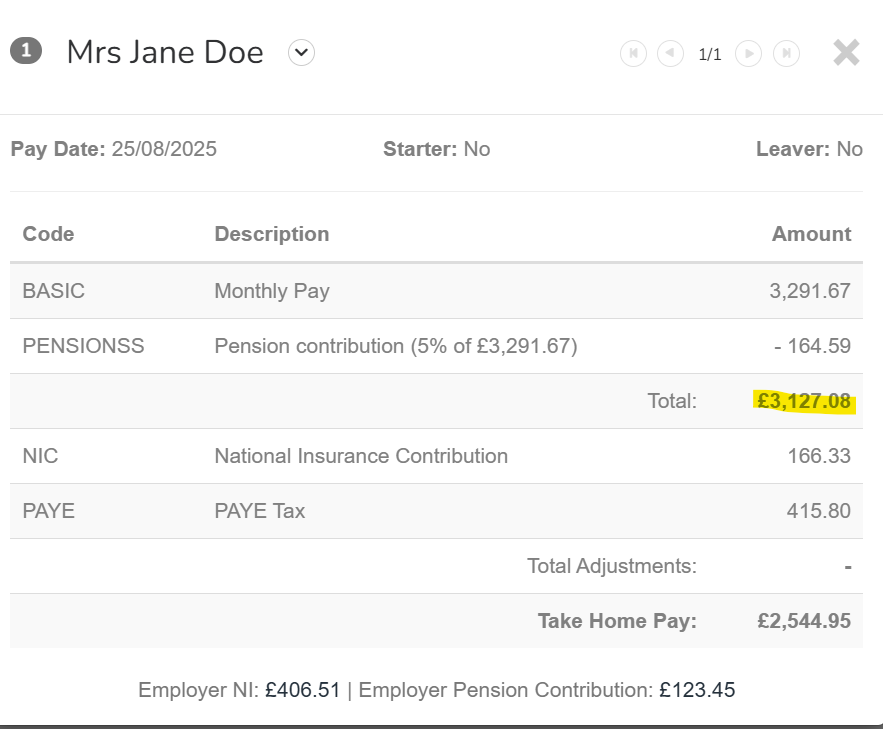
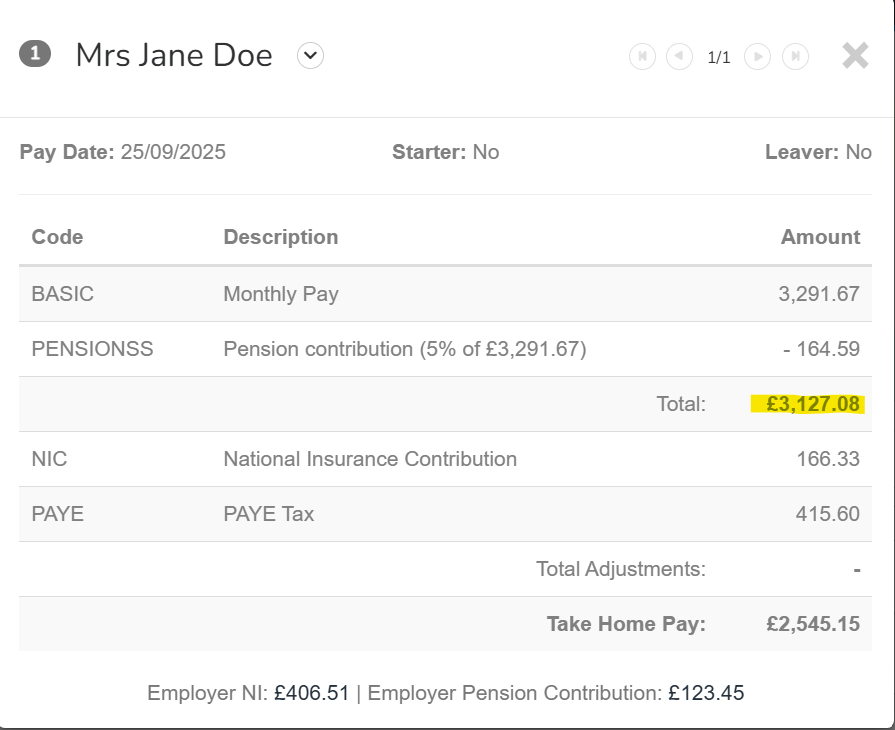
Next, take the last 2 payslips before that qualifying week. In the case of the example it’s the August and September payslip.
Step 4
Start by adding all the earnings for those two periods, then divide by 2. This calculates the average earnings in the qualifying period.
Next, multiply by 12 (months in the year) and finally divide by 52 (weeks in the year).
For example:
- 3127.08 + 3127.08 = 6254.16
- 6254.16 / 2 = 3127.08
- 3217.08 X 12 = 37524.96
- 37524.96 / 52 = 721.63
This calculates the average weekly earnings, which the payroll system calculates based on the qualifying period.

The first 6 weeks are paid at 90% of gross earnings. The remaining weeks are then paid at statutory or 90% of AWE, whichever is lower.
To identify the statutory maternity pay value, take the AWE of 721.63 x 90% = 649.48.
Finally, multiply this by the number of weeks in the period of work (in the example above, it is 4 weeks, so 649.48 x 4 = 2597.92).
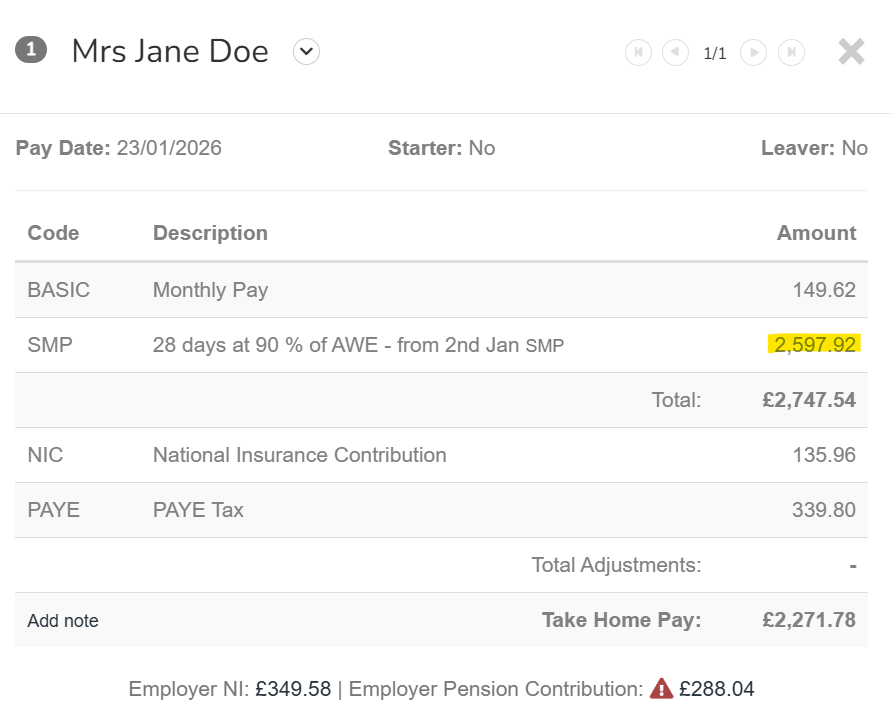
Please note, SMP cannot be sacrificed and the full value will be added onto the employer portion.
Troubleshooting: addressing under-calculated maternity pay in the final period
If the system calculates a partial monthly payment (e.g., 22 days) for an employee, it's typically because they completed their 273 day (39 week) SMP qualifying period. This usually results in a shortened final payment month, reflecting the remaining days in the month/SMP period.
Lorem ipsum dolor sit amet elit
Lorem ipsum dolor sit amet, consectetur adipiscing elit, sed do eiusmod tempor incididunt ut labore et dolore magna aliqua. Ut enim ad minim veniam, quis nostrud exercitation ullamco laboris nisi ut aliquip ex ea commodo consequat. Duis aute irure dolor in reprehenderit in voluptate velit esse cillum dolore eu fugiat nulla pariatur.