Running a small pension scheme? These are the four questions you need to ask yourself
In four simple questions, here’s our take on why the majority of smaller own trust pension schemes will make the move to alternative arrangements over the next few years

Running a small pension scheme? These are the four questions you need to ask yourself
We’ve already seen a huge increase in trustees and managers of smaller pension schemes (those with less than £100m under management) getting in touch with us.
We forecast that the majority of these pension schemes will make the move to alternative arrangements over the next few years. In four simple questions, here’s our take on why.
1) Can you prove to The Pensions Regulator that your scheme has good governance?
Companies with their own pension schemes with less than £100m under management are facing greater scrutiny from The Pensions Regulator, adding additional costs and time to running your scheme. Driving consolidation of pension schemes is the Regulator’s stated aim and further legislation is promised if it doesn’t happen fast enough.
The increased regulatory burden will come with a focus on making sure that schemes are being run with the right knowledge, competencies, risk management and governance in place. The trustee board will have to ensure that default investment strategies are suitably designed for members, while there will be a requirement for core scheme financial transactions to be processed promptly and accurately.
Our view
These new regulations are going to come thick and fast and drive lots of work to justify keeping your scheme. Why increase your risk of getting a fine running your own scheme when you don’t need to? You could switch to another trust where you carry much less risk in both the short term and the long run.
2) Can you prove to The Pensions Regulator that your scheme offers its members value for money?
Trustees will need to carry out a Value for Money test annually against three other schemes – and one of them will have to be one that you could move your scheme into. How will your scheme stack up to this new Value for Money test? Do your trustees have time to do this?
Our view
We believe this test will be a tough challenge for schemes. It will force the question of why would you spend money on your scheme - building up-to-date technology, improved investment strategies and better governance, when an alternative trust could offer all three, straight out of the box?
3) Who is ultimately footing the bill for running your pension scheme?
Many pension managers and trustees are beginning to realise that the costs of running these schemes can be very high – and that these costs have to be paid for, either by the company itself or by scheme members.
If you – or your scheme – are paying for your own trustees, your own governance, your own scheme administration and your own investment strategy, chances are you – or your scheme members – are paying too much.
Our view
Why incur costs when you don’t need to? Simple economies of scale mean that if a smaller workplace scheme switches to a larger trust, the costs of running the scheme are much less because they are spread across larger numbers of members. You can cut costs without cutting corners – and, in many cases, you can get much more for much less.
4) Does moving your scheme sound like a lot of work?
Don't let the barrier of moving put you off. It’s worth running the numbers to see what moving to a larger trust could save you in the medium to long term, it’s likely in the long run you and your members will be better off financially.
Our view
Moving to a master trust doesn’t need to be a complex or costly process and could help you meet changing regulatory requirements. We’re experienced in successfully managing onboarding for employers of all sizes, from small start-ups to large enterprises. You can find us listed on The Pension Regulator’s website here. Our technology automates much of the data transfer process and our dedicated implementation manager takes care of the project from start to finish.
Who are we?
Smart Pension was created to modernise the retirement industry in the UK. Now, we’re enhancing our award-winning master trust to be the best choice for every employer. We take a different approach to traditional pensions by putting our customers first, and our purpose-built platform makes saving easy and secure for our members.
With Smart Pension, members can expect an experience more like their online banking provider, with everything you need in an app on your phone, including tools to check you’re on track with your savings goals, the ability to change your contribution or add additional money, compare and switch your investments, and even save and take from your pension when you reach minimum retirement age - all in a paperless and seamless way.
Let’s talk: Free 30 minute pension consultation
If you have any concerns or questions about running your workplace pension scheme, we can help. We’d be delighted to offer you a free 30-minute discussion with a senior pension consultant to discuss your options - with no cost, no ties and no obligation.
Get in touch
About Smart Pension
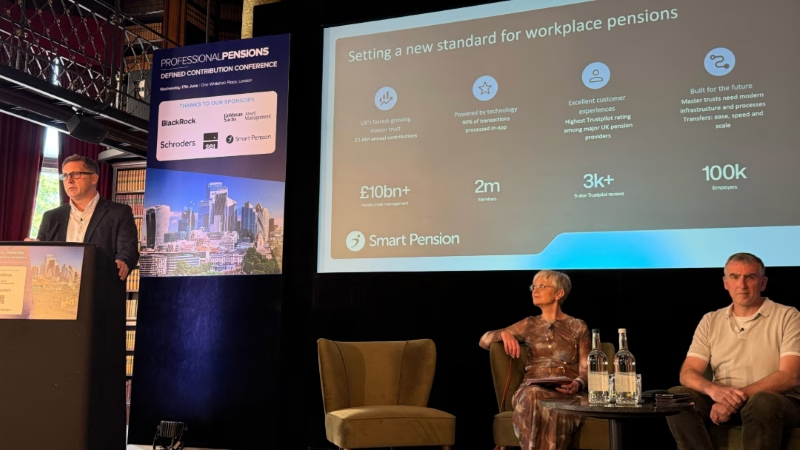
Launched in 2015, Smart Pension now exceeds £10bn in Assets Under Management (AUM) and serves 2 million members and 100,000 employers. It is powered by Keystone, Smart’s global savings and investments technology platform.
Aquiline, Barclays, Chrysalis Investments, DWS Group, Fidelity InternationalStrategic Ventures, J.P. Morgan, Legal & General Investment Management, MUFG and Natixis Investment Managers are all investors in Smart Pension.